
Sovereign video meeting platform
Dorbar.
Your meetings. Inside your boundary.
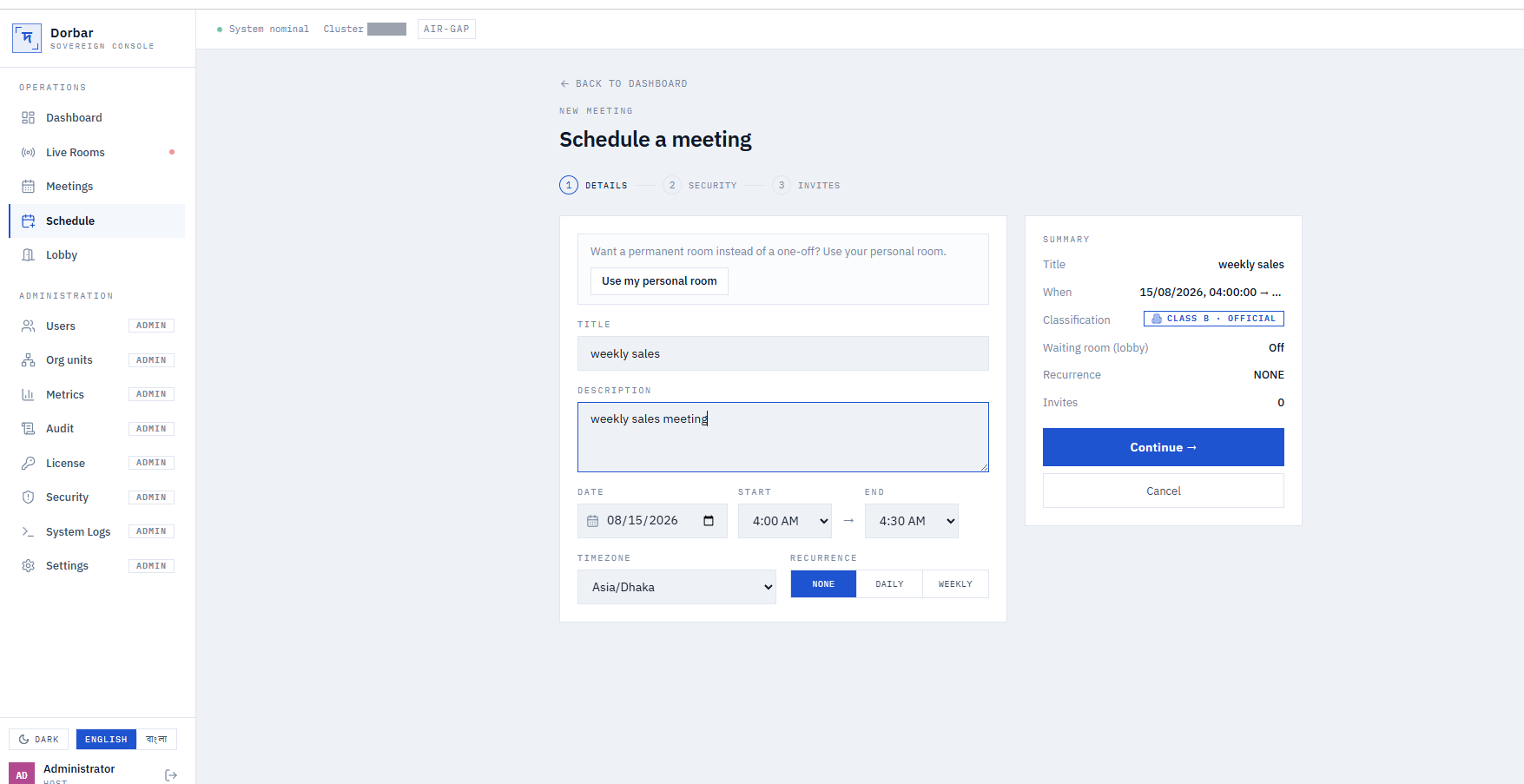
Dorbar is a sovereign video-meeting platform for governments and regulated enterprises, run inside your own boundary. A meeting's security class — and who may join it — is fixed when it is scheduled, not left to participants, and the interface runs in Bengali or English at full parity.
Self-hosted meetings. Official-room media is protected in transit.
Capabilities
Run the meeting. Keep control.
Review the capabilities and their availability. Built features are distinguished from live functionality.
Classification set at scheduling
Whoever schedules a meeting fixes it as Official or Sealed up front, and that classification travels with the room's join credential so the client and server always agree on what the room is allowed to do.
Sealed end-to-end encryption
Sealed rooms are designed to encrypt every media frame on each participant's device using MLS (RFC 9420) group keying, SFrame media encryption, and a post-quantum X-Wing hybrid key exchange, so the meeting server relays only ciphertext and cannot see the content.
Official-room recording
In an Official room a host can record the session to in-cluster object storage, with a start confirmation, an always-visible recording badge for every participant, and a per-join notice; Sealed rooms cannot be recorded by design.
Offline transcription
Completed Official recordings are transcribed by an in-cluster speech model that runs fully offline with no cloud speech service, producing a timestamped, language-detected transcript.
Live captions
Official rooms can show real-time captions from an offline in-cluster speech model in English or Bengali with a host-selected language, shipped switched off by default and never offered in Sealed rooms.
Sensitive-data classification and redaction
Transcripts are scanned offline for categories such as personal, payment-card, and health data, extendable with operator-defined patterns, and the sensitive text is masked on read for anyone who lacks the elevated view permission.
Explore 4 more capabilities
Host moderation and lobby
Hosts admit or deny people from a waiting room, lock the room, mute or remove participants, reassign in-room roles, and spotlight a speaker, with the join gate enforced before anyone reaches the media server at all.
Tamper-evident audit trail
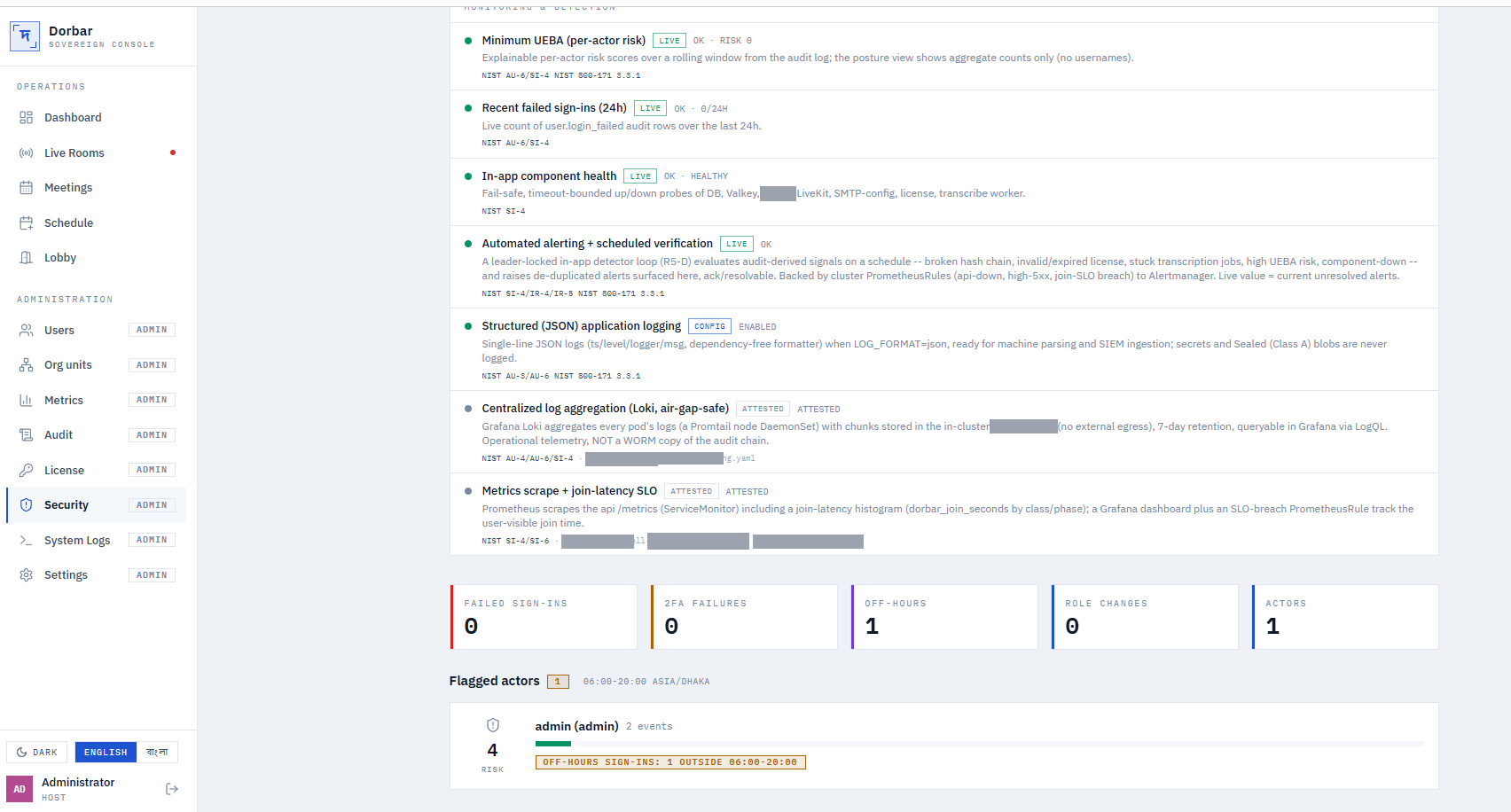
Every consequential action is appended to a SHA-256 hash-chained audit log that can be recomputed and verified on demand, so any alteration, deletion, or reordering of the record is detectable.
Bengali and English parity
The entire interface is available in English and Bengali at full parity with self-hosted fonts and no content delivery network, so the platform reads natively for its users with no external dependency.
Air-gap-capable deployment
The meeting server, database, object storage, STUN/TURN, and speech models all run inside a single cluster with no external runtime dependency, packaged for installation into a disconnected network from a mirrored registry.
Inside Dorbar
A closer look at the controls.
Inspect the real interface. Open the image to explore the details at full size.
Under the surface
The details that shape your deployment.
The two-class room model
Dorbar does not treat every meeting the same. At schedule time each room is fixed as one of two mutually exclusive classes, and that choice is carried end to end.
Official rooms are the on-premises-trusted default. The meeting server inside your own hardened cluster is the trust anchor, media is protected in transit, and because the server can read the media it can record, transcribe, live-caption, and moderate the session. Official rooms are protected in transit only and are never end-to-end encrypted.
Sealed rooms are designed for the most sensitive sessions. This encryption path is built but dormant, not live. In that design, media is end-to-end encrypted on each participant's device, so the meeting server relays only ciphertext and every server-side feature that would touch content, including recording, transcription, captions, and breakout rooms, is refused by design. The two classes cannot be blurred or mixed within one room.
Availability: live captions ship switched off by default. Assurance limit: the Sealed end-to-end encryption runs at the browser tier and is currently rated medium assurance pending an independent external cryptographic review; a hardened native-client tier is a later phase.
Sovereign identity and access
- Mandatory two-factor sign-in
- Local accounts require a time-based one-time-password second factor on every fresh session, with the secret encrypted at rest. LIVE.
- Separate platform and meeting roles
- Administrative reach and in-meeting authority are two independent role dimensions mapped to permissions in config, so holding one never grants the other. LIVE.
- Single-sign-on federation
- Organizations can federate to their own identity provider over OpenID Connect and delegate multi-factor to it; ships off by default and enabled per deployment.
- Smart-card / client-certificate sign-in
- Users can authenticate with a client certificate on a smart card, verified at the ingress; ships off by default and enabled per deployment.
- Offline signed licensing
- Seat and term entitlement is carried in an offline cryptographically signed license with no phone-home; ships off by default and enforced only where turned on.
Before you evaluate
Availability & limits
Sealed-room encryption is built but dormant, not live, and remains pending external cryptographic review. Air-gap deployment is built, not live. Live captions ship switched off by default. Official rooms are protected in transit, not end-to-end encrypted. Recording cannot be paused mid-session; local recording is not built.
Common questions
A little more context.
What are Official and Sealed rooms in Dorbar?
Two room classes, fixed when a meeting is scheduled. Official rooms are server-trusted and protected in transit — the media server handles the streams. Sealed rooms are designed for end-to-end encryption, but this capability is built and dormant, not live. It is rated medium assurance pending external cryptographic review. Official rooms are never end-to-end encrypted.
How does Dorbar control who can join a meeting?
Classification and access are set on the meeting at scheduling, not left to participants, with a lobby and waiting-room control and host moderation. Administrative reach and in-meeting authority are two independent role dimensions, so holding one never grants the other.
Does Dorbar work in Bengali?
Yes — the interface runs in Bengali or English at full parity, which is the point for Bangladesh government and regulated-sector deployments.
Can meetings be recorded and transcribed?
Official rooms support recording and offline transcription, over a tamper-evident audit trail of the security-relevant events. Recording cannot be paused mid-session, and local client-side recording is deliberately not built.
Your next step
Sovereign meetings, inside your own boundary.
Talk with an engineer. See the product against a scenario that matters to your team.
A conversation with the people building the product.