
Database activity monitoring
Vyrell.
Know what happens to your data.
Vyrell reads your databases’ native audit trails through low-privilege accounts. Investigate activity, review detection rules, and prepare compliance reports without installing a monitoring agent on production databases.
Runs in your environment; hosted evaluation on request.
Capabilities
Understand activity. Act on evidence.
Review the capabilities and their availability. Built features are distinguished from live functionality.
Ten database engines
Oracle, MySQL and MariaDB, PostgreSQL, MSSQL, MongoDB, Cassandra, Db2, Sybase ASE, Couchbase, and Firebird.
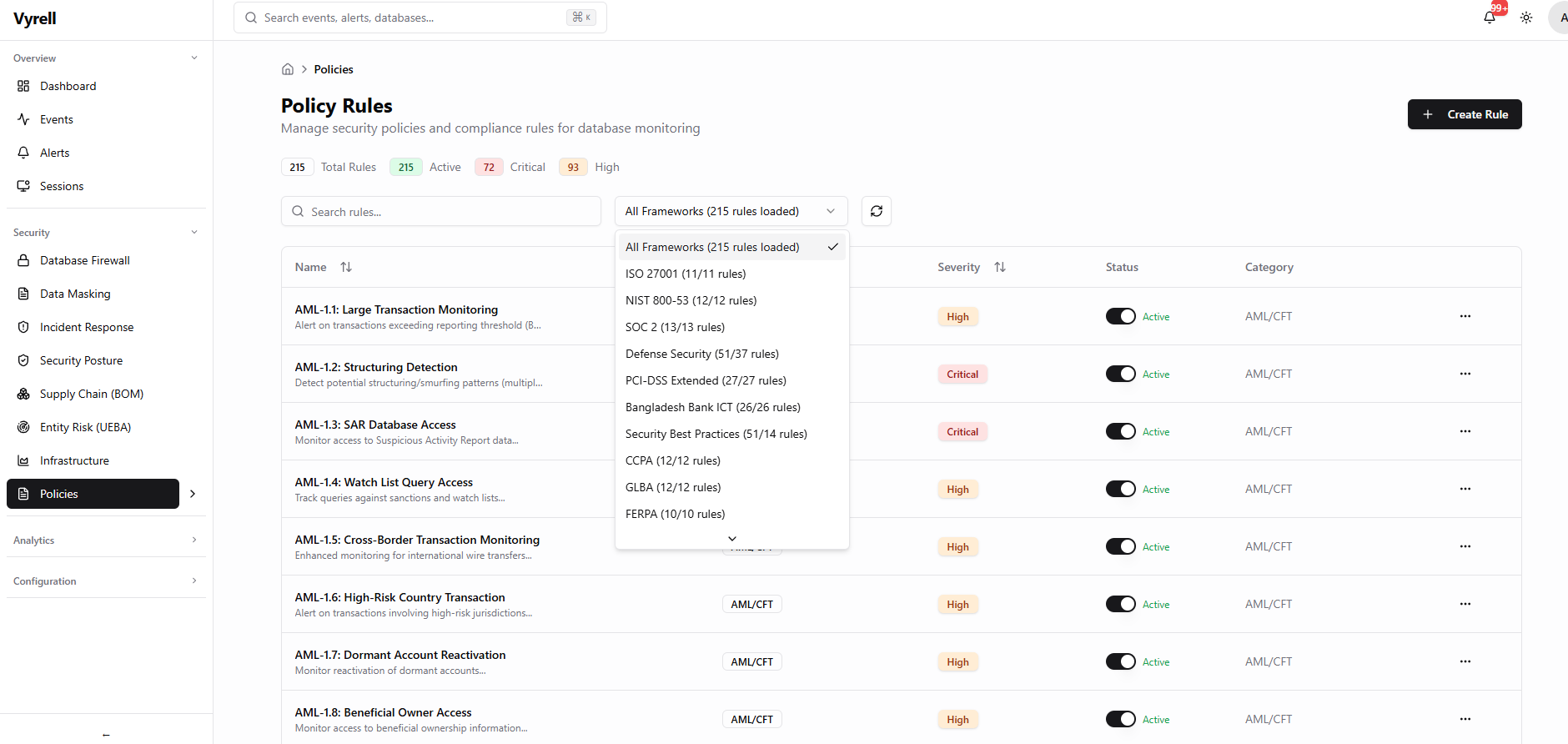
215 security rules
Pre-built detection for privileged access, policy violation, and suspicious activity, evaluated against every event.
21 compliance frameworks
PCI-DSS, HIPAA, SOX, GDPR, NIST 800-53, ISO 27001, SOC 2, and fourteen more.
Agentless deployment
A read-only audit account per target. No software on the production database.
Real-time alerting
Email, webhooks, SIEM forwarding, and in-app notification, routed by severity.
Behaviour analytics
Users, hosts, IPs, and applications scored against their own baselines with peer-group comparison.
Explore 6 more capabilities
Bangladesh Bank ICT v4.0
26 guideline rules in the policy library, with a matching report in the reporting engine.
Tamper-evident audit trail
SHA-256 hash-chained, insert-only, with a daily verifier for chain breaks and sequence gaps.
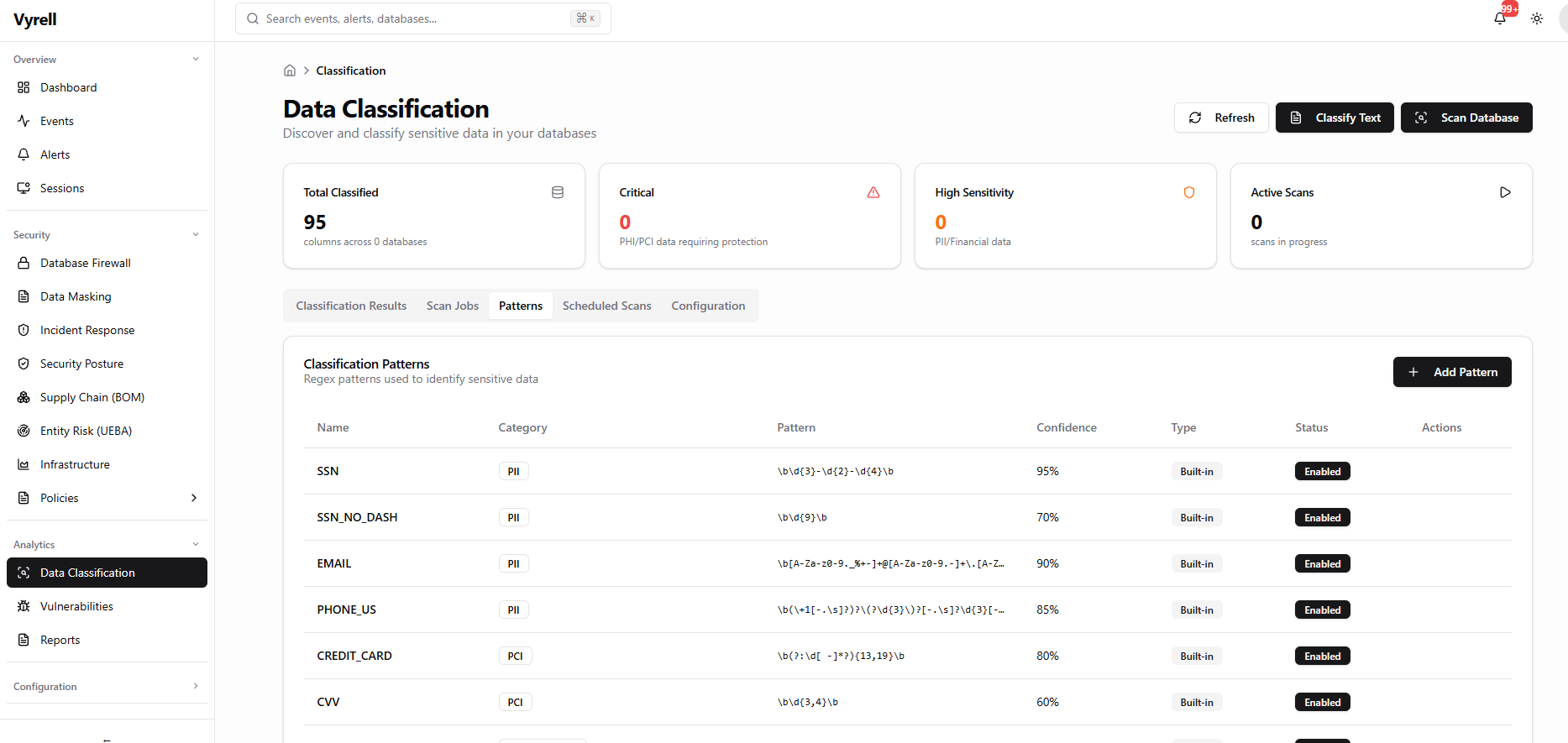
Sensitive data discovery
Column and table scanning classifies PII, health, and payment data, then proposes masking policies.
Vulnerability scanning
Scheduled scans match monitored engine versions against published CVE data.
Enforced two-factor
TOTP on by default, LDAP sign-on, group-to-role mapping, progressive lockout.
Reports that show gaps
A timed-out query marks its report incomplete with no score, rather than rendering a pass.
Inside Vyrell
A closer look at the controls.
Inspect the real interface. Open the image to explore the details at full size.
Under the surface
The details that shape your deployment.
Supported engines and audit prerequisites
- Oracle
- Unified auditing
- MySQL / MariaDB
- Audit plugin
- PostgreSQL
- pgaudit
- Microsoft SQL Server
- SQL Server Audit
- MongoDB
- Audit log
- Cassandra
- Audit logging
- IBM Db2
- db2audit
- Sybase ASE
- Native auditing
- Couchbase
- Audit events
- Firebird
- Trace and audit
Access and integrations
- Two-factor enforced by default
- TOTP is on for every account, with LDAP directory sign-on, group-to-role mapping, and progressive lockout.
- Role-scoped visibility
- One console for the whole estate, with each operator’s permissions scoped to what they are allowed to see.
- Alerting into your stack
- Email, webhooks, SIEM forwarding, and in-app notification, routed by severity.
How agentless collection works
Your database’s native audit facility records activity. Vyrell reads that trail through a low-privilege account and applies detection rules centrally. Audit configuration and read permissions are prerequisites. There is no monitoring agent or inline appliance in the database data path.
Before you evaluate
Availability & limits
The Sybase ASE and Cassandra connectors are not yet supported on Kubernetes deployments. Engine audit configuration and read access are prerequisites. Inline SQL firewall and query-time masking enforcement are not live capabilities.
Common questions
A little more context.
What does Vyrell monitor, and how?
Vyrell watches database activity across ten engines — Oracle, MySQL and MariaDB, PostgreSQL, SQL Server, MongoDB, Cassandra, Db2, Sybase ASE, Couchbase, and Firebird — by reading each engine's native audit facility through a read-only account. Nothing is installed on the production database.
Which compliance frameworks does Vyrell cover?
Twenty-one framework rule-packs ship in the policy library — including PCI-DSS, HIPAA, SOX, GDPR, ISO 27001, and the Bangladesh Bank ICT Security Guideline v4.0 (26 rules) — each with a matching report in the reporting engine.
How long does Vyrell take to deploy?
One to two days. Because it is agentless — a read-only audit account per target — there is no software to roll out on the production databases.
How is Vyrell different from a traditional DAM appliance?
There is no inline appliance and no agent on the database, so Vyrell adds no chokepoint in the data path. It reads each engine's native audit stream through a read-only account, and its audit trail is SHA-256 hash-chained and insert-only, with a daily verifier for chain breaks and sequence gaps.
Does Vyrell use machine learning?
No. Its behaviour analytics score users, hosts, IPs, and applications against their own statistical baselines with peer-group comparison — a statistical engine, not a machine-learning model.
Your next step
See your database security more clearly.
Talk with an engineer. See the product against a scenario that matters to your team.
A conversation with the people building the product.